After Capture - Six Industrial Pathways for Atmospheric Carbon
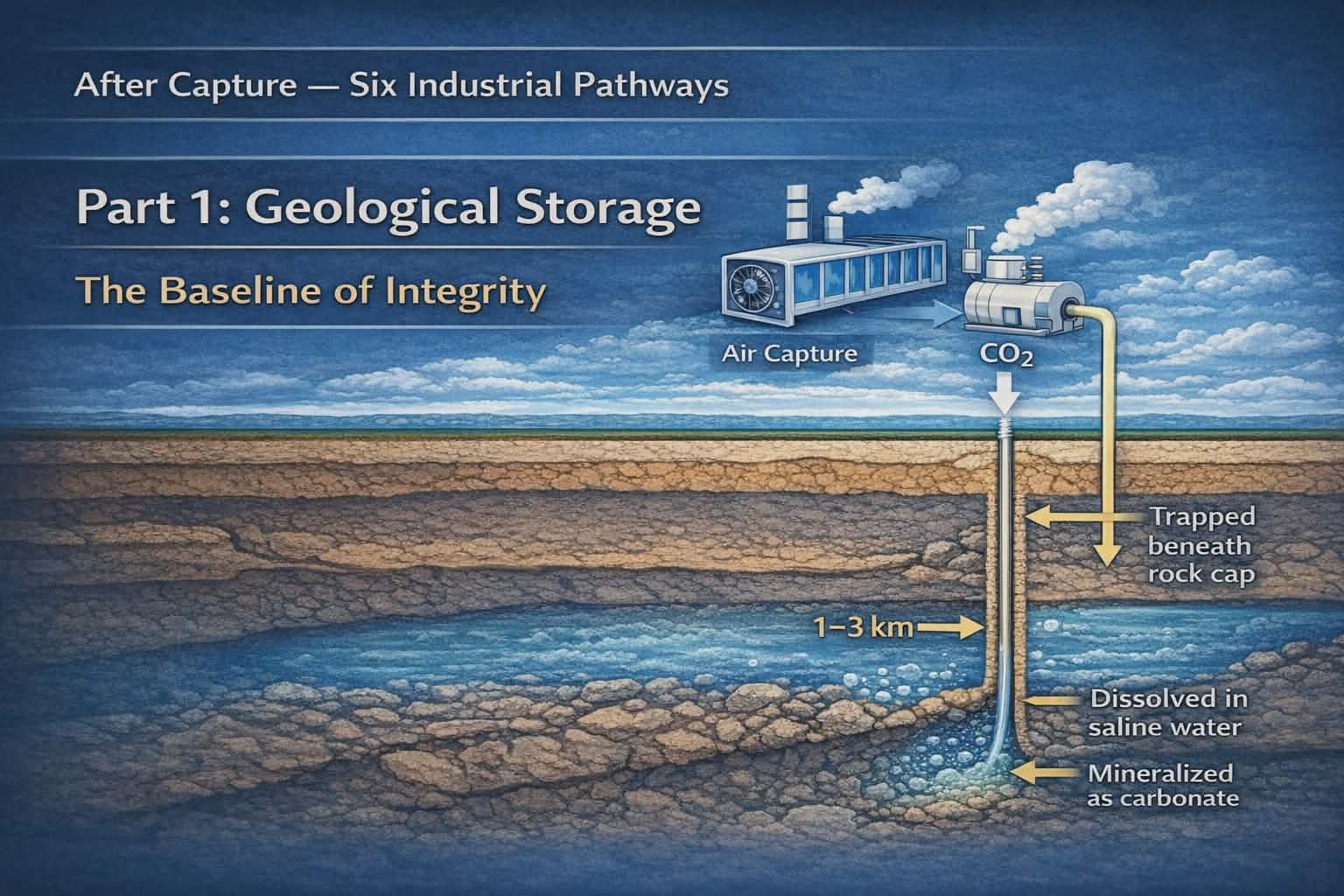
Geological Storage - The Baseline of Integrity
Direct air capture is often criticized for one simple reason:
What do you actually do with the carbon once you capture it?
The debate usually divides into two camps.
One side argues that captured carbon should be reused — turned into fuels, materials, or industrial inputs.
The other side argues that the only truly meaningful solution is permanent removal.
Both perspectives matter. But before we explore the industrial pathways where carbon becomes a useful resource, we have to start with the baseline option.
Geological storage.
Not because it is the most exciting outcome.
But because it is the most reliable one.
Carbon Vaults Beneath Our Feet
Geological carbon storage works by injecting captured CO₂ deep underground into porous rock formations.
These formations are typically:
- saline aquifers
- depleted oil and gas reservoirs
- basalt formations capable of mineralization
Once injected, the carbon becomes trapped through multiple mechanisms:
- Structural trapping beneath impermeable rock layers
- Dissolution into underground fluids
- Mineralization reactions with surrounding rock
Over time, the gas gradually transforms from a mobile fluid into stable carbonate minerals.
In other words, the carbon becomes stone.
This is not theoretical chemistry.
It is already happening in places like the Northern Lights Project, where captured CO₂ from industrial emitters across Europe is transported offshore and injected into deep saline reservoirs beneath the North Sea.
The concept is simple.
The atmosphere is the problem.
The Earth's crust is the vault.
Why Storage Matters
Critics sometimes dismiss storage as the “lazy option” — burying carbon rather than finding productive uses for it.
But from a systems perspective, storage performs a crucial role.
It provides certainty.
If carbon is converted into fuels or industrial products, it will eventually return to the atmosphere when those products are used.
Storage is different.
It removes carbon from circulation for geological time scales.
That permanence is why long-term storage is often considered the gold standard for carbon removal.
It creates a measurable, verifiable outcome:
Captured carbon that does not come back.
The North Sea Carbon Basin
Northern Europe is quickly becoming the world’s most advanced testing ground for geological carbon storage.
The region has three critical advantages:
- Extensive offshore geological formations suitable for storage
- Existing energy infrastructure from decades of offshore oil and gas production
- A dense industrial base producing concentrated CO₂ streams
The result is an emerging carbon storage network beneath the North Sea.
Captured carbon can be:
- transported via pipelines
- shipped to offshore terminals
- injected into deep geological reservoirs
In many ways, this system resembles the infrastructure that once moved fossil fuels — only now it operates in reverse.
Instead of extracting carbon from the Earth, we are returning it.
Storage as the Baseline
Geological storage establishes the baseline against which all other carbon pathways must be measured.
It is not always the most economically attractive option.
It does not generate fuel.
It does not produce materials.
But it does something extremely valuable.
It guarantees removal.
That reliability is why nearly every serious carbon capture strategy includes a storage component somewhere in the system.
Because before carbon can become a commodity…
It must first become manageable.
The Real Decision
Once carbon is captured and storage becomes technically possible, the real decision begins.
Should the carbon be locked away permanently?
Or should it become part of a new industrial cycle?
In the next article, we explore the first alternative pathway:
Turning carbon into a useful industrial material.
Because once carbon is captured, it is no longer just waste.
It becomes a resource.
Series Navigation
After Capture — Six Industrial Pathways for Atmospheric Carbon
Part 1 — Geological Storage: The Baseline of Integrity
Part 2 — Industrial Reuse: Carbon as a Material
Part 3 — Synthetic Fuels: Recycling Carbon for Mobility
Part 4 — Biological Carbon Cycles
Part 5 — Energy System Balancing
Part 6 — Carbon Materials: Mining the Atmosphere
Part 7 — The Carbon Hub Architecture
Comments ()