Beyond Electrons: The Missing Infrastructure of Europe’s Energy Transition
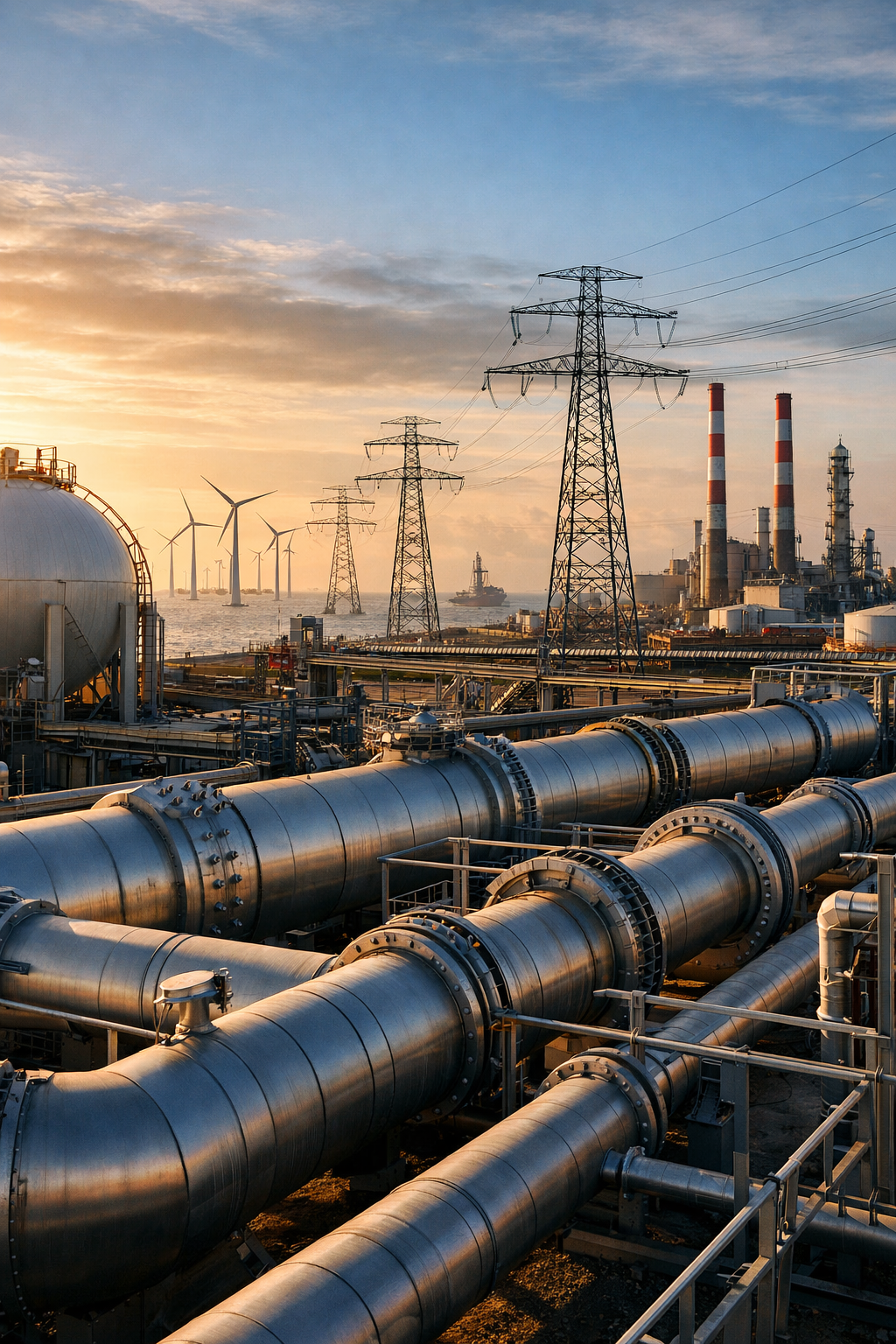
Europe’s energy transition is usually discussed in terms of technologies.
More wind.
More solar.
More hydrogen.
More batteries.
But technologies are no longer the real constraint.
The real constraint is the infrastructure between them.
Pipelines.
Ports.
CO₂ transport networks.
Underground storage.
Industrial heat systems.
These systems determine whether technologies scale — or stall.
Energy transitions are infrastructure stories
History shows the same pattern again and again.
The oil economy was not built by drilling alone.
It required pipelines, refineries, and global tanker fleets.
The natural gas economy did not emerge simply because gas was discovered.
It emerged because pipeline networks and LNG terminals connected markets.
Electricity itself only became a dominant energy carrier once transmission grids expanded across entire continents.
Technologies create possibility.
Infrastructure creates reality.
Europe’s energy transition is now entering the same phase.
The Three Layers of the Energy System
To understand the next phase of the transition, it helps to look at the system in three layers.
|
Layer |
Primary Asset |
Hidden Constraint |
|
Electrons |
Wind / Solar / HVDC |
Permitting & land use |
|
Thermal / Carbon |
Geothermal / Industrial Heat / DAC |
Co-location & efficiency |
|
Molecular Infrastructure |
Hydrogen pipelines / CO₂ networks |
Logistics & storage |
Most public discussion focuses on the first layer.
But the deeper constraints are increasingly emerging in the second and third layers.
The Copper vs Steel Problem
The transition is often framed as a massive electrification challenge.
Build more grids.
Move more power.
Expand interconnectors.
But electricity moves through copper wires and pylons, which require land, permitting, and long construction timelines.
Molecular energy — hydrogen, natural gas, and CO₂ — moves through steel pipelines.
From an energy density perspective, pipelines can transport enormous volumes of energy through relatively small physical corridors.
This is why Europe’s emerging hydrogen corridors and CO₂ transport networks are not peripheral projects.
They represent a different way of moving energy through the economy.
Electrons will power much of the future system.
But the transition cannot rely on electrons alone.
The Storage Illusion
Storage discussions are often dominated by batteries.
Batteries are essential for balancing power systems over seconds, minutes, and hours.
But Europe’s energy system also faces seasonal imbalances.
Winter demand can surge while renewable output drops during extended periods of low wind and sun.
Bridging those periods requires weeks or months of storage, not just hours.
This is where the infrastructure layer becomes decisive.
Salt caverns.
Underground gas storage.
Geothermal reservoirs.
Thermal storage systems.
These geological assets provide storage capacity on a scale that electrochemical batteries cannot easily match.
Europe’s largest “battery” is not made of lithium.
It is buried underground.
The Port Concentration Paradox
The energy transition is often described as decentralised.
Rooftop solar.
Distributed generation.
Local energy communities.
Yet the infrastructure supporting the transition is becoming more geographically concentrated.
Offshore wind assembly yards.
Hydrogen import terminals.
CO₂ export hubs.
Critical mineral supply chains.
These activities are increasingly centred around a handful of major European ports.
Rotterdam.
Antwerp.
Hamburg.
The North Sea industrial cluster.
These locations are quietly becoming strategic energy nodes.
Generation may decentralise.
But energy logistics are centralising.
The resilience of Europe’s future energy system may depend as much on dockside infrastructure as on the power grid.
Beyond Electrons
This article is the first in a series called Beyond Electrons, exploring the infrastructure systems shaping Europe’s energy transition.
Future posts will examine topics such as:
• CO₂ transport and storage networks
• Hydrogen infrastructure and gas grid repurposing
• Energy ports and logistics bottlenecks
• Industrial decarbonisation clusters
• Underground storage and geological infrastructure
Because the next phase of the energy transition will not be defined only by new technologies.
It will be defined by the systems that connect them.
Clean energy is only the beginning.
The real challenge is building the infrastructure that allows it to move, transform, and scale.
Comments ()