The Energy Transition Is Moving Underground
Abstract
While surface renewables dominate public discussion, the decarbonization of heat and long-duration energy storage increasingly depends on subsurface infrastructure. This shift positions the North Sea’s engineering ecosystem - built over decades of oil and gas development - as a critical foundation for geothermal energy, carbon storage, and underground hydrogen systems.
The Blue Lagoon Lesson
The Blue Lagoon in Iceland exists because geothermal engineers once discharged silica-rich geothermal brine into surrounding lava fields.
What began as a technical discharge management problem gradually became one of the country’s most visited sites.
But the real lesson of Iceland’s geothermal infrastructure is not tourism.
It is how deeply energy systems can become embedded in the ground beneath our feet.
And that may turn out to be one of the defining characteristics of Europe’s energy transition.
The Visibility Bias
Most discussions about the energy transition focus on what we can see.
Wind turbines on the horizon.
Solar panels covering rooftops.
Transmission lines stretching across landscapes.
These visible technologies have become the symbols of decarbonization.
Yet the infrastructure that may ultimately determine the stability of Europe’s energy system is far less visible.
It lies beneath the ground.
Energy sovereignty is no longer a matter of harvesting what is above the ground, but of managing what is below it.
The Hidden Half of Energy
Electricity dominates public debate about the energy transition.
But electricity represents only a fraction of Europe’s energy system.
Across the European Union, heat accounts for roughly half of final energy consumption, supplying buildings, industrial processes, and district heating networks.
In Northern Europe, district heating systems already supply millions of homes, creating infrastructure that could potentially integrate geothermal heat sources in the future.
The decarbonization challenge therefore extends far beyond power generation.
It involves three interconnected tasks:
- producing low-carbon heat
- storing energy across seasons
- managing industrial carbon emissions
Each of these challenges increasingly points toward solutions located underground.
Geothermal reservoirs can provide continuous heat.
Depleted hydrocarbon formations can store carbon dioxide.
Underground caverns can store hydrogen to balance renewable electricity systems.
The transition, in other words, is not only about generating clean electricity.
It is about engineering the subsurface.
The Subsurface Technology Platform
Although geothermal energy, carbon capture and storage (CCS), and hydrogen storage are often discussed as separate technologies, they share a common technical foundation.
All three depend on the same industrial capabilities:
- deep drilling
- reservoir modeling
- well integrity management
- pressure monitoring and subsurface simulation
Techniques such as logging-while-drilling (LWD), reservoir simulation, and pressure transient analysis form the backbone of these systems.
For decades, these capabilities were developed in the oil and gas industry.
Today they are increasingly being adapted for a different purpose.
Instead of extracting hydrocarbons, they are being used to produce heat, store carbon, and buffer renewable energy systems.
This emerging framework can be understood as a subsurface technology platform.
The North Sea Industrial Cluster
Few regions in the world possess the engineering capacity required to build this platform.
Over the past fifty years, the North Sea basin has become one of the most sophisticated subsurface engineering ecosystems ever assembled.
Cities such as Aberdeen, Stavanger, and Hamburg host dense networks of drilling contractors, geophysical modeling teams, reservoir engineers, and energy service companies.
Major industry players—including SLB, Baker Hughes, and Halliburton—helped develop the technologies and operational practices that define modern well engineering.
In total, the North Sea region contains more than 30,000 drilled wells, representing decades of accumulated knowledge about how reservoirs behave over time.
This knowledge base cannot easily be replicated.
The North Sea is not a declining resource basin; it is Europe’s most critical engineering laboratory.
Geological Co-location
The geological formations that once powered Europe’s hydrocarbon economy may now serve a different role.
The same sedimentary basins that held oil and gas are increasingly being evaluated as multi-purpose energy infrastructure.
Depleted reservoirs can store carbon dioxide.
Hot aquifers can provide geothermal heat.
Salt caverns can store hydrogen.
This phenomenon can be described as geological co-location.
Multiple components of the future energy system may operate within the same geological structures.
In that sense, the North Sea basin is evolving from a hydrocarbon extraction zone into a subsurface energy platform.
The Industrial Constraint
However, building this platform requires more than geology.
It requires industrial capacity.
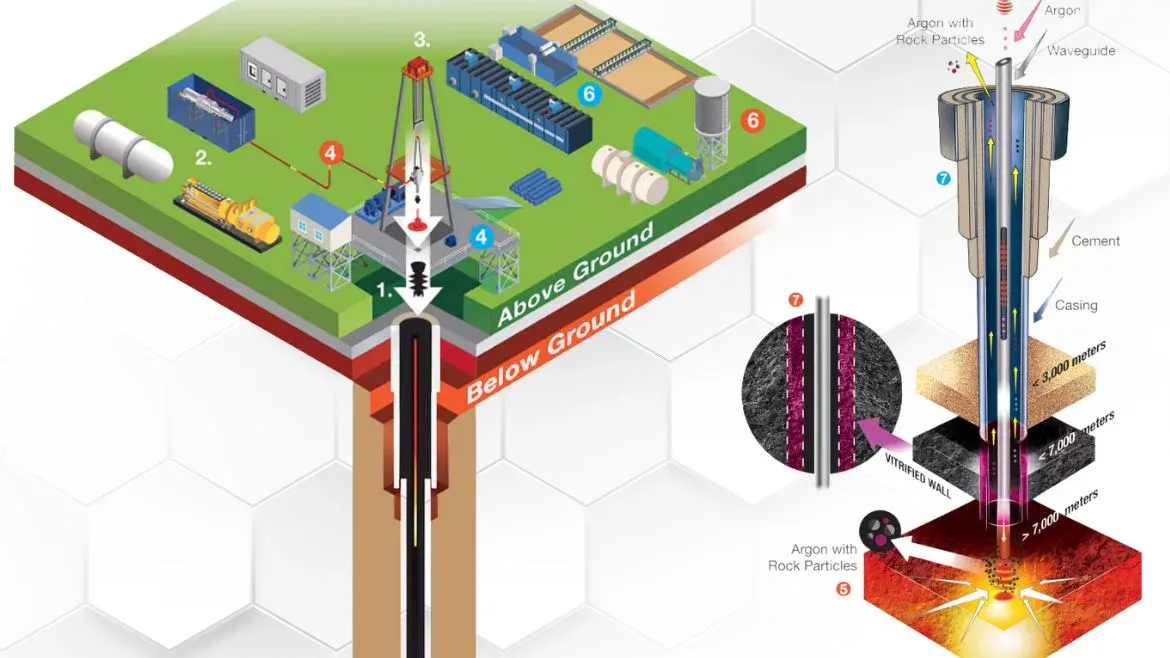
Geothermal wells often reach depths of 3–5 kilometers, equivalent to drilling roughly fifteen Eiffel Towers straight down into the Earth.
Deep geothermal wells can also involve drilling through harder rock formations and operating at temperatures exceeding 200°C, conditions that push beyond the design limits of many conventional oil and gas tools.
Carbon storage projects require injection wells capable of operating reliably for decades.
Hydrogen storage caverns require specialized drilling and monitoring systems.
Each of these technologies depends on the same critical assets:
- drilling rigs
- highly trained crews
- reservoir engineering expertise
- long-term well integrity management
Maintaining subsurface integrity is essential not only for operational performance but also for safety, requiring careful pressure monitoring and long-term reservoir management to prevent leakage or induced seismicity.
And these assets are not unlimited.
If geothermal development, carbon storage deployment, and hydrogen storage expansion accelerate simultaneously, they will increasingly compete for the same industrial resources.
The speed of the energy transition will not be determined by the speed of policy, but by the availability of a drilling rig.
A Workforce Transition
The energy transition represents a shift in mission, not a reinvention of expertise.
The engineers who built Europe’s offshore oil industry may also build the infrastructure of its low-carbon energy system.
Reservoir engineers who once optimized hydrocarbon recovery may model geothermal heat extraction.
Drilling crews that developed offshore fields may drill wells for geothermal district heating systems.
Geoscientists who mapped hydrocarbon traps may identify formations suitable for carbon storage.
Subsurface expertise does not disappear when hydrocarbon production declines.
It evolves.
From Exploration to Infrastructure
The economic model, however, changes.
Oil and gas exploration historically operated on a high-risk, high-reward framework.
A successful discovery could produce extraordinary returns.
Subsurface energy infrastructure behaves differently.
Geothermal heat systems, carbon storage projects, and hydrogen storage facilities resemble long-lived utility assets.
While the technical risk remains subsurface, the financial profile shifts from venture-style discovery to infrastructure-bond stability.
The focus moves from finding resources to managing infrastructure.
From wildcatting to engineering.
The Strategic Question
Europe possesses many of the ingredients required to build this underground energy system.
The geology exists.
The engineering expertise exists.
The industrial heritage of the North Sea provides a foundation that few other regions can match.
But the transition raises a fundamental question.
Can Europe preserve and coordinate the subsurface engineering capacity required to build this new infrastructure across national borders?
Because while wind turbines and solar panels may dominate the visible landscape of the energy transition, a significant portion of the system that supports them will remain invisible.
It will be drilled, modeled, and managed kilometers beneath the surface.
And the future of Europe’s energy system may depend on how well we learn to manage the ground beneath our feet.
For post Header:
Most discussions about the energy transition focus on what we can see.
Wind turbines. Solar panels. Transmission lines.
But the infrastructure that may determine the stability of Europe’s future energy system is largely invisible.
It lies beneath the ground.
In the article below I explore how geothermal energy, carbon storage, and hydrogen storage are turning the North Sea into a subsurface energy platform — and why the engineers who built Europe’s offshore oil industry may end up building the next phase of the energy transition.
Because the real question may no longer be about renewable generation.
It may be about who has the capability to engineer the subsurface at scale.
Comments ()